
SPRIBE Plinko: How to Play, Multipliers, and Game Mechanics
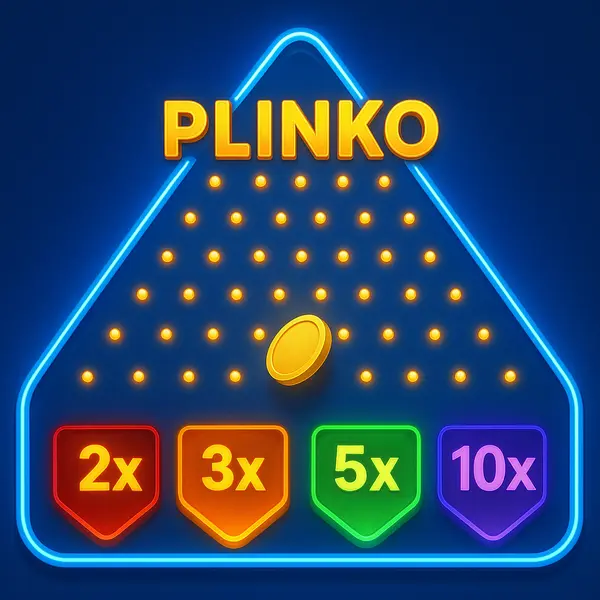
SPRIBE Plinko is an instant game built around a simple drop-and-win mechanic, offering rapid rounds similar to crash releases like Spaceman. Instead of tumbling reels seen in slots like Starlight Princess, the game uses a peg-filled board where a ball moves downward before landing in one of the payout positions at the bottom.
At Olymp Casino, players in Bangladesh can access Plinko from compatible desktop and mobile devices. The gameplay is easy to understand, while the selected risk level determines how the potential multipliers are distributed across the board. This guide explains how SPRIBE Plinko works, how a round is settled, how risk affects potential results, and what players should know before starting a session.
How SPRIBE Plinko Works
The basic mechanic of SPRIBE Plinko is straightforward. A player first selects the stake and configures the available game parameters. After confirming the bet, a ball is released from the upper part of the Plinko board.
As the ball travels downward, it encounters a series of pegs. At each collision, its trajectory changes, eventually leading it toward one of the payout positions at the bottom of the board.
Each bottom position is associated with a multiplier. When the ball reaches its final position, the selected multiplier is applied to the initial stake and the result of the round is settled immediately.
The player does not need to predict the exact route of the ball. The outcome is determined by the game’s randomisation system, while the visual animation shows the ball’s path from the top of the board to the final payout position.
SPRIBE Plinko Risk Levels and Multiplier Distribution
One of the most important settings in Plinko is the risk level. Rather than changing the basic drop mechanic, the risk setting changes the distribution of potential multipliers across the board.
The general principle is simple: configurations with greater potential rewards also involve greater variance. Lower-risk settings tend to concentrate more outcomes around the central part of the payout distribution, while higher-risk settings place more emphasis on larger multipliers located farther from the centre.
Low Risk
The low-risk configuration is designed around a more conservative multiplier distribution. The central payout positions represent the outcomes that are easier to reach statistically, while the potential rewards toward the edges remain more limited than in higher-risk configurations.
This setting may be suitable for players who prefer smaller fluctuations between individual rounds rather than pursuing the largest available multipliers.
Medium Risk
Medium risk provides a compromise between the central and outer payout positions. The potential multipliers are distributed more aggressively than under low risk, while the game still retains a relatively broad range of more frequently occurring central outcomes.
For players who want a balance between variance and potential payout, medium risk provides a natural middle configuration.
High Risk
High risk produces a much wider potential payout distribution. The central positions can have substantially smaller multipliers, while the outer positions can offer significantly larger returns.
The important point is that selecting a high-risk configuration does not make a large multiplier more likely simply because its value is higher. The larger payouts correspond to less frequent outcomes, which increases the volatility of individual rounds.
Why the Plinko Ball Usually Lands Near the Centre
The visual structure of Plinko resembles a physical Galton board. At every level, the ball can move in different directions after contacting a peg. After multiple successive deflections, a large number of possible trajectories can converge on the central positions.
By comparison, reaching an extreme position requires a much more unusual sequence of directional movements. This is why the central part of the board generally contains more frequently reached payout positions, while the outer positions can be associated with larger multipliers.
This distribution is important when interpreting the game’s risk settings. A high multiplier should not be treated as a guaranteed target. Its value reflects the trade-off between potential payout and the probability of reaching that position.
How to Play SPRIBE Plinko: Round-by-Round Process
A typical Plinko round at Olymp Casino follows a short sequence:
- Select the stake: Choose the amount to wager on the next ball.
- Choose the risk level: Select the available risk configuration according to the desired volatility.
- Start the round: Confirm the bet and release the Plinko ball.
- Follow the trajectory: The ball moves through the peg field and changes direction after successive collisions.
- Receive the result: Once the ball reaches a bottom position, the corresponding multiplier is applied to the stake and the round is settled.
Example of a Plinko Payout Calculation
Consider a hypothetical round with a 100 BDT stake. If the ball lands in a position carrying a 2.00x multiplier, the resulting payout is 200 BDT.
If the ball instead reaches a position with a 0.50x multiplier, the payout is 50 BDT. A result above 1.00x returns more than the original stake, while a result below 1.00x returns less than the amount wagered.
| Example Multiplier | Stake | Payout | Result Relative to Stake |
|---|---|---|---|
| 0.50x | 100 BDT | 50 BDT | 50 BDT below stake |
| 1.00x | 100 BDT | 100 BDT | Stake returned |
| 2.00x | 100 BDT | 200 BDT | 100 BDT above stake |
| 5.00x | 100 BDT | 500 BDT | 400 BDT above stake |
Manual and Automated Plinko Play
SPRIBE Plinko is designed around rapid individual rounds, making it possible to play manually while maintaining a consistent betting routine.
Manual Play
In manual play, the player initiates each individual drop. After the result is settled, the next round can be configured and started separately. This approach gives the player an opportunity to review the previous result and adjust the stake or risk setting before continuing.
Automated Play
Where automated functionality is available in the casino interface, players can use predefined betting parameters to run multiple rounds without manually starting every drop. Automation should be configured carefully because a sequence of rapid bets can increase the amount wagered during a session.
SPRIBE Plinko on Mobile Devices
The instant-game format is particularly suitable for mobile play because a Plinko round does not require a large number of interface controls. The essential elements are the stake controls, risk configuration, game board, and result display.
On a smartphone, the responsive interface allows the player to follow the ball’s movement and see the final multiplier without requiring a desktop-sized screen. This makes Plinko convenient for short sessions on modern Android and iOS devices through a compatible mobile browser.
RNG, RTP, and Fairness in Plinko
The outcome of an online Plinko round is determined by the game’s underlying randomisation system rather than by the player’s ability to control the ball after it has been released.
RTP, or Return to Player, is a theoretical long-term percentage used to describe how much a game is expected to return across a very large number of rounds. It should not be interpreted as a guaranteed return for an individual player or session.
The same principle applies to the game’s multiplier distribution. A high-value multiplier can produce a substantial payout when it occurs, but its presence does not mean that the outcome is likely to appear in any particular sequence of drops.
Players should therefore evaluate Plinko in terms of probability, variance, and the configured risk level rather than attempting to identify a predictable sequence in the ball’s trajectory.
Demo Play and Real-Money Plinko
If a demo version of SPRIBE Plinko is provided by the casino, it can be used to familiarise yourself with the interface before placing real wagers. Demo play removes the financial component while allowing players to understand the drop sequence, multiplier display, and available settings.
Real-money play uses the player’s actual casino balance and therefore carries financial risk. The transition from demo to real-money play does not turn the game into a skill-based system: the outcome of each round remains dependent on the game’s randomisation mechanism.
| Feature | Demo Play | Real-Money Play |
|---|---|---|
| Balance | Virtual credits | Actual casino balance |
| Financial Risk | No real-money stake | Real financial risk |
| Main Purpose | Learn the interface and game mechanics | Play for potential monetary returns |
Managing Risk During a Plinko Session
Plinko rounds are short and can be repeated rapidly, so session management is an important part of responsible play.
- Set a fixed budget: Decide how much you are prepared to spend before starting a real-money session.
- Choose risk deliberately: Higher potential multipliers also mean greater variance and more pronounced swings between results.
- Do not chase losses: Increasing the stake after an unsuccessful round does not improve the probability of receiving a particular multiplier on the next drop.
- Keep the session controlled: Automated or rapid play can increase the number of wagers made in a short period, so predefined limits are useful.
SPRIBE Plinko combines a simple drop mechanic with configurable risk and multiplier distributions. The game is easy to understand at a basic level, but the relationship between probability, variance, and payout size is important when evaluating different configurations. Players can use demo play where available to learn the interface and should treat real-money rounds as games of chance rather than as a predictable system.